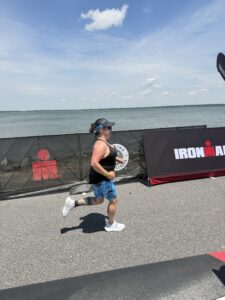
After spending the weekend at Endurance Exchange, we know that athletes are using AI to write training plans. We get it, sport is expensive and where you spend your money matters.
You can train for a triathlon with a spreadsheet, a templated plan, an AI chatbot, or a human coach. And honestly? AI can be great for quick structure, ideas, and “what should I do today?” guidance.
But if your goal is to progress faster, stay healthier, and show up on race day feeling ready, 1-on-1 coaching still has some unfair advantages—especially for 20–29-year-olds juggling work, social life, travel, late nights, and the occasional “I forgot I agreed to a weekend trip.”
Here’s the real breakdown.
What AI is genuinely good at (and why people love it)
AI shines when you need:
- Instant answers (fueling ideas, workout swaps, technique cues)
- A plan “good enough” to keep you consistent
- Low-cost structure without commitment
- Motivation on demand (“tell me I can do this”)
Some studies suggest AI-based coaching can improve physical activity in certain populations, showing it can be helpful for behavior change in scalable ways.
But triathlon is not just “be more active.” It’s three sports, plus recovery, plus life.

Where AI starts to fall short for triathlon training
1) AI doesn’t truly know you (and triathlon is personal)
A plan is only as good as how well it fits:
- your injury history
- your stress + sleep patterns
- your biomechanics and technique gaps
- your training age
- your schedule constraints
- your personality (do you need a push, or do you need permission to back off?)
There’s a growing body of evidence that individualized, evolving training—adjusted based on how the athlete is responding—can reduce “non-response” and improve adaptation compared to fixed plans.
That’s basically the core job of a coach: make the plan respond to your reality.
2) Coaching helps you do the right work, not just more work
One common failure mode for ambitious 20-somethings: you stack intensity because you can—until your body invoices you later.
Triathlon coaches commonly focus on training load management (especially run load) to reduce injury risk, and research on age-group triathlon coaching highlights how coaches monitor and adjust training load—particularly to minimize injuries.
There’s also triathlon-specific work emphasizing that training load monitoring and smart controls matter for performance and injury prevention. AI is not going to text you and say, based on your feedback and your metrics – we need more REST.

AI can talk about “recovery,” but it won’t reliably catch the subtle pattern of:
“Your run volume spiked, your sleep dipped, your mood is flat… and you’re one more hard session away from losing 3 weeks.”
A good coach will.
3) Accountability isn’t a “nice-to-have”—it’s a performance tool
If you’re 20–29, life changes fast. New job. New city. Weddings. Travel. Random busy seasons.
Coaching creates a feedback loop:
- you report how things went
- your coach adjusts the next steps
- you stay consistent even when life gets chaotic
And consistency is the quiet superpower in endurance sports.
Even outside triathlon, research comparing training approaches often shows more supervised / coach-led formats can improve outcomes like adherence and performance vs. self-directed methods. We learned this weekend, athletes are using AI and then hiring a coach.
(Yes—triathlon isn’t resistance training, but the behavior pattern carries: structure + feedback + accountability tends to beat “do it yourself” when the goal is measurable progress.)
The biggest advantage of 1-on-1 coaching: decision-making
Here’s what most athletes don’t realize until they’ve been doing this awhile:
The hard part isn’t finding workouts.
The hard part is deciding:
- when to push
- when to hold steady
- when to back off
- how to adjust when something goes wrong
- how to peak for your specific race

AI gives you options.
A coach gives you decisions.
And fewer decisions = more energy for actually training.
Why this matters specifically for 20–29-year-olds
In your 20s, you often have:
- enough fitness potential to improve quickly
- enough motivation to overdo it
- enough life volatility to need flexibility
So the best coaching isn’t “harder.” It’s smarter:
- building durability (especially run durability)
- adding intensity at the right time
- protecting recovery
- keeping training realistic so you don’t burn out
AI can generate a plan. A coach builds an athlete.
Where Sonic Endurance fits in
If you want that personalized approach, Sonic Endurance is built around one-on-one coaching with a team support model—meaning you get your personal coach plus the collective experience of the broader coaching staff.
A few practical things that matter for modern athletes:
- We coach triathletes, swimmers, cyclists, and runners (so you’re not getting a “generic endurance plan”).
- We also offer structured training programs delivered in platforms athletes actually use (TrainingPeaks), which makes execution easier even when life is busy.
If you’re the kind of person who likes tech, data, and structure—but also wants a real human to connect the dots—that hybrid is powerful.
The “best of both worlds” approach (what I’d recommend)
You don’t have to pick a side like it’s a rivalry.
A high-performing setup often looks like:
- Coach = strategy, personalization, load management, accountability
- AI = quick Q&A, workout substitutions, fueling ideas, race-day checklists
In other words: let AI be your assistant. Let a coach be your guide.
Quick self-check: do you need a coach right now?
1-on-1 coaching is especially worth it if you:
- keep getting minor injuries or “niggles”
- plateau despite training hard
- struggle with consistency because life is chaotic
- want a specific result (first Olympic, sub-5:30 70.3, Kona slot someday, etc.)
- are unsure how to balance intensity across 3 sports
- want confidence that you’re peaking correctly
If you’re just trying to finish your first sprint and you love experimenting solo, AI + a good beginner plan might be plenty—for now.
But if you want to level up and protect your body while doing it? That’s where coaching earns its cost.