The warm weather has arrived and open water swim season is upon us. We kicked off our open water swim season and here are a few thoughts on how to help you when you swim in open water.
Get Comfortable Before Race Day
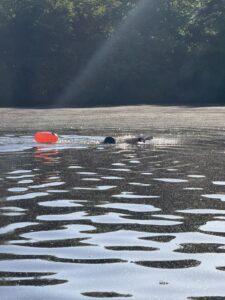
If your first open water experience is the race itself, you’re making things harder on yourself. Try to get at least one or two practice swims in the same type of water — lake, bay, ocean — before the event. Even 20 minutes of open water time helps your brain adjust to the unfamiliar environment: murky water, reduced visibility, the absence of a bottom to reference. This can help immensely with open water swim anxiety.
What should I wear?
Wetsuit or no wetsuit depends on water temperature and race rules, you can check our our thoughts on wearing a wetsuit here Most open water events allow wetsuits when water temps are below 76–78°F. Wetsuits add buoyancy and warmth — both helpful for beginners — but they can feel restrictive around the shoulders if you’re not used to them. Practice in yours before race day.
Regardless of wetsuit, apply body glide or anti-chafe balm around your neck, underarms, and anywhere your suit rubs. Saltwater and repetitive motion will find any vulnerable spot.
For goggles, match the lens to conditions. Clear or light-tinted lenses work well for overcast days or evening swims. Dark or mirrored lenses are worth the investment for morning races when you may be swimming directly into the sun. Speaking of sighting, especially on those early morning swim starts
Sighting: How to Swim Straight
Without a lane line to follow, even strong swimmers drift. Sighting is the skill of briefly lifting your eyes above the waterline to spot a landmark and confirm you’re on course — and it’s one of the most valuable things to practice.
The basic technique: As your lead arm extends forward, press down slightly on that arm to lift your goggles just above the surface. Take a quick peek, then immediately rotate into your normal side breath. Keep the motion minimal — you want your eyes above water, not your whole head. Lifting too high drops your hips and creates drag. If you know that you have one side that is stronger than the other, you can off set that by bilateral breathing.
What to sight on: Buoys are the obvious target, but they sit low and disappear in chop. Look for something bigger behind them — a tall tree, a building, a flag. Pick your landmark before you start and know what you’re looking for.
How often: Every 6–10 strokes is a good starting point. As your stroke straightens out, you can stretch that to every 15–20. Over-sighting disrupts your rhythm, so trust your stroke between looks.
Sighting into the sun: Morning races can put the sun directly in your eyes. If you can’t see your buoy, navigate off a taller secondary landmark instead. Other swimmers are also useful — the pack generally goes the right direction. Mirrored or polarized goggles help significantly, so check the race start time and plan your gear accordingly. If you do decide to follow a swimmer, make sure they are heading in the right direction.
Also note, open water swimming burns more energy than pool swimming — sighting, dealing with chop, and the excitement of a race all add up. Start slower than you think you need to. It’s much easier to negative split an open water race than to blow up in the first 200 meters and struggle home. If you do find that you are struggling to get your breathing under control, pop your head up and allow yourself a reset, you can breaststroke to keep the forward momentum.
We can control a lot of things with our training. We cannot control the weather that shows up on race day. Calm water is a gift. More often, you’ll deal with some combination of wind, waves, and surface chop — and how you handle it determines a lot of how your race goes.
Swimming in chop: Short, choppy waves disrupt your breathing rhythm more than your stroke. The key is flexibility — be willing to breathe on both sides so you can always rotate away from a wave. If you’re a one-side breather, practice bilateral breathing before race day. Getting a mouthful of water mid-race is disorienting; training both sides gives you options. If you are in salt water and you get a mouthful, try not to swallow it as it can cause GI distress.
Headwind and oncoming waves: Shorten your stroke slightly and focus on a strong catch rather than a long glide. A long lead arm pause just gives the wave more time to push you back. Keep your tempo up and your head low.
Crosswind and current: Wind pushes water, and water pushes you. If there’s a consistent crosswind, you’ll drift downwind even with a straight stroke. Aim upwind of your target — how much depends on the strength of the wind, but even a few degrees of compensation makes a big difference over distance. Check periodically whether your drift correction is working and adjust.
Tailwind: Enjoy it. Let the waves carry you a little, extend your glide, and conserve energy for the harder legs of the course.
Sighting in chop: Waves can block your view entirely on a low sight. In rough conditions, sight slightly higher than normal — enough to clear the surface — and accept that you’ll lose a bit of efficiency. Sighting twice in quick succession (two strokes apart) can help confirm what you saw on the first look.
The bottom line: rough conditions slow everyone down. Don’t panic if your pace feels off. Stay relaxed, adjust your breathing, and keep moving forward.
Open water swimming rewards preparation, but it also rewards showing up. The swimmers who improve fastest aren’t necessarily the most talented; they’re the ones who get in the water regularly, pay attention, and come back for the next one.