If you’ve ever stood in transition at 5:30am wondering why the Head or Local Technical Officials look like they’re fishing off the docks, you’ve witnessed one of the most important — and least glamorous — jobs in our sport: the water temperature check. As Technical Officials, our goal on race day is to gather this information early, so we spend a good chunk of the pre-race morning thinking about wetsuits, water temps, and making sure everyone gets a safe, fair swim. So, I wanted to break down how this all actually works, straight from the rulebook (v.2026.01.01 USA Triathlon Multisport Competition Rules and the 2026 USAT Rules Variances and Equipment Clarifications), in plain, human language.
First Things First: Why Do We Even Care About Wetsuits?
Wetsuits aren’t just about staying warm — they also add buoyancy and reduce drag, which can be a real performance boost. So USAT has built a whole framework around when they’re prohibited, allowed, permitted, or mandatory, balancing three things: safety, fairness, and performance and Section 3.4 of the rulebook lays this out in detail.
The Water Temperature Chart Breakdown
For most of us racing in USAT Sanctioned Local Races, here’s the chart that governs your swim, straight from Section 3.4.1:
Category Temperature Range What It Means
PROHIBITED 84.0°F (28.9°C) and above No wetsuits allowed, period.
ALLOWED 78.1–84.0°F (25.6–28.8°C) You can wear one, but you give up awards/ranking eligibility.
PERMITTED 60.7–78.0°F (16.0–25.5°C) Wetsuits welcome, no strings attached.
MANDATORY 60.6°F (15.9°C) and below You must wear one — safety first.
Now, Let’s Talk Safety and Concerns
This is really the heart of why all these tables and thresholds exist. A few things I think about constantly on race morning:
Risk of Overheating Wetsuits are built to trap body heat — great in cold water, dangerous in warm water. Above 78°F, that insulation can work against you, pushing your core temperature up even while you’re swimming. That’s a real heat-illness risk, not a hypothetical one.
Safety Concerns This is exactly why race organizers (and the rulebook) get conservative above 78°F. It’s not about taking away your gear — it’s a proactive move to keep athletes from overheating in open water, especially in smaller, more exposed venues where temps can swing quickly.
Loss of Competitive Advantage Wetsuits boost buoyancy and cut drag — real advantages in cool water. But in warm water, that edge shrinks (or even backfires), which is part of why the rules draw a line: it keeps things fair across the field.
Rule Compliance and Awards Eligibility This one trips people up every season: if you wear a wetsuit in the 78.1–84.0°F “Allowed” band at a non-National Age-Group race, you can absolutely still swim — but you’re not eligible for rankings or awards unless a specific variance is posted. I always remind athletes at check-in: it’s not a DSQ, it’s an eligibility issue.
Practical Swim Performance Ditching the wetsuit in warm water means a bit more kicking and a touch less glide — but you also lose the drag and overheating downside. Most athletes find that trade-off is worth it once the water gets warm.
Practice and Comfort Level My biggest piece of advice as an official (and fellow athlete): don’t wait until race morning to find out how you swim without a wetsuit! Train in a range of conditions throughout your season — wetsuit and no wetsuit — so you’re not caught off guard by whatever Mother Nature (and the thermometer) decides on race day. Comfort and confidence in the water are just as trainable as your bike and run splits.
Beyond Just the Suit – What’s Permitted vs. Not
This is where things get interesting, because it’s not only about the wetsuit itself:
Wetsuit specs (always):
· Max 5mm thickness anywhere (Section 3.2.1)
· Must cover at least torso and back when mandatory
· Must fit snugly — no baggy suits flapping around
When wetsuits are PROHIBITED (warm water):
· Swimwear must be 100% textile (no rubber/neoprene) — think standard tri suits or swimskins
· Can’t cover the neck, can’t go past elbows or knees
· Neoprene/wetsuit bottoms (buoyancy shorts) are banned in this scenario at most competition levels
When wetsuits are PERMITTED/MANDATORY:
· Neoprene boots/socks? Allowed — but no webbing between toes (no “helping” your propulsion)
· Gloves are only allowed when wetsuits are mandatory, and again, no webbing
Always prohibited, regardless of temp:
· Snorkels (see 2026 USAT Rules Variances below), fins, artificial propulsion devices, and personal flotation devices in competitive races (Section 3.3)
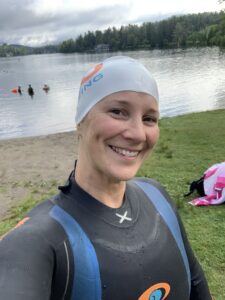
Now, here’s a fun local-race nuance from the 2026 USAT Rules Variances and Equipment Clarifications doc — at the Local Race level, we actually have more flexibility than Elite/National races:
· Buoyancy shorts: Not allowed at Elite/U23/Development/National/World Qualifier level — but allowed at USAT Sanctioned Local Races and Adaptive Triathlon races (must stay above the knee, below the hip line, max 5mm).
· Snorkels: Same story — banned at the higher competitive tiers, but permitted locally (with a heads-up to race management beforehand).
· Swim buoys: Must stay undeployed in competitive local waves, but can be deployed in Non-Competitive waves (with the athlete starting at the back of the final wave).
So as a Local Official, part of my job is knowing that “the rules” aren’t monolithic — what applies to a Local Sprint might be totally different from what applies to someone chasing a Nationals qualifying slot.
The Bottom Line
Every one of these thresholds, charts, and equipment rules exists for one reason: keeping you safe while keeping the race fair. As officials, we’re not out there to nitpick your gear (well…..sometimes ) — we’re making sure that whatever the water temp throws at us, everyone gets a fair and safe shot at the finish line.
So next time you see us out there with a thermometer at dawn, know that we’re doing it for you. See you at the swim start!